
PERFORMANCE
DELIRIUM FOR TWO
TEASER
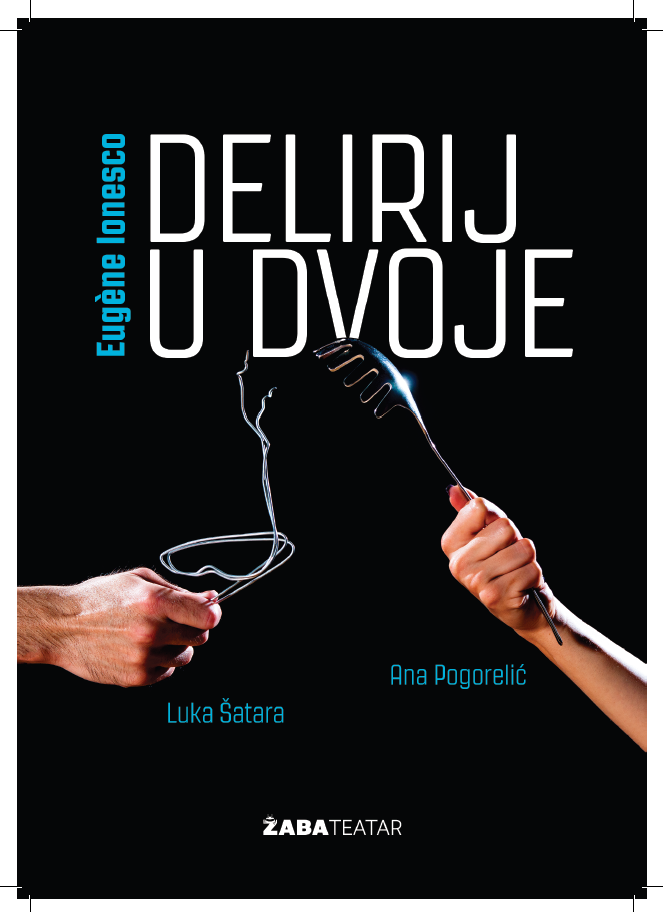
Translation and adaptation: Ana Pogorelić
Direction, scenography, motion and visuals:
       Ana Pogorelić i Luka Šatara
Actors: Ana Pogorelić i Luka Šatara
Music: Katarina Ranković
Lighting and tone: Miroslav Marčetić
Costume: Ana i Nina Pogorelić
Costume making: Đurđa Prlić
Image making: Jana Friščić
Make-up: Dino Baksa
Photography: Timor Šatara
Graphic design: Denis Stankov
Eugène Ionesco, one of the key figures of 20th-century French avant-garde theatre, sparked a revolution in drama, inspired by a dark vision of a world full of decay and meaningless, repetitive actions. His work explores an aversion to the tangible world, distrust of verbal communication, and a constant sense that a better world exists, but remains beyond our reach. He was fascinated by human ignorance toward oneself and others, by the unconscious immersion in trivial daily routines that inevitably lead to despair, culminating in death as the only irrevocable event. Yet even amid this bleakness, Ionesco’s texts contain an element of hope, reflecting his own aspiration to “destroy the walls of reality that actually separate us from the true reality.”
Humour plays a central role in his work. In Delirium for Two, two spouses locked in a room during a civil war outside discuss a turtle and a snail, argue, and alternately mourn the past and a possible future. These absurd yet recognizable situations resonate with audiences, offering both reflection and a subtle aspiration for improvement.
The inspiration for Delirium for Two (original title: Délire à deux, 1962) comes from a rare mental disorder known as induced joint psychosis or “madness for two” (folie à deux in French). The condition involves the transmission of delusional ideas or abnormal behaviour from one person to another, typically within a close emotional relationship, with one dominant individual inducing the delusion in the other. Social isolation – a frequent element in the Theatre of the Absurd – often contributes to this phenomenon. In the play, She and He debate whether a snail and a turtle are the same animal. The discussion escalates into madness, partially reconstructing their shared past, while the boundaries between reality and the surreal remain deliberately blurred in all Ionesco’s plays. Their allegorically simple names allow the characters (She and He) to embody the full spectrum of human emotion, from euphoria to despair.
The original title is Delirium for Two, but it has commonly become known as Madness for Two, although at Teatar &TD the play was performed under the title Frenzy for Two, translated by Vladan Švacov.
Musical fragments are incorporated throughout the performance, enhancing the atmosphere of absurdity and intensity.
- C. Debussy: Clair de lune (iz Suite bergamasque)
- J. Haydn: Sonata u Es-duru, Ho b XVI/49, II stavak
- L. van Beethoven: Turski marš (iz 6 varijacija, op.76)
We sincerely thank the ensemble for their enthusiasm, Ms. Elica Osvald, Prof. Danko Friščić, and all our friends for their invaluable support.
Translation and adaptation: Ana Pogorelić
Direction, scenography, motion and visuals:
       Ana Pogorelić i Luka Šatara
Actors: Ana Pogorelić i Luka Šatara
Music: Katarina Ranković
Lighting and tone: Miroslav Marčetić
Costume: Ana i Nina Pogorelić
Costume making: Đurđa Prlić
Image making: Jana Friščić
Make-up: Dino Baksa
Photography: Timor Šatara
Graphic design: Denis Stankov
Eugène Ionesco, one of the key figures of 20th-century French avant-garde theatre, sparked a revolution in drama, inspired by a dark vision of a world full of decay and meaningless, repetitive actions. His work explores an aversion to the tangible world, distrust of verbal communication, and a constant sense that a better world exists, but remains beyond our reach. He was fascinated by human ignorance toward oneself and others, by the unconscious immersion in trivial daily routines that inevitably lead to despair, culminating in death as the only irrevocable event. Yet even amid this bleakness, Ionesco’s texts contain an element of hope, reflecting his own aspiration to “destroy the walls of reality that actually separate us from the true reality.”
Humour plays a central role in his work. In Delirium for Two, two spouses locked in a room during a civil war outside discuss a turtle and a snail, argue, and alternately mourn the past and a possible future. These absurd yet recognizable situations resonate with audiences, offering both reflection and a subtle aspiration for improvement.
The inspiration for Delirium for Two (original title: Délire à deux, 1962) comes from a rare mental disorder known as induced joint psychosis or “madness for two” (folie à deux in French). The condition involves the transmission of delusional ideas or abnormal behaviour from one person to another, typically within a close emotional relationship, with one dominant individual inducing the delusion in the other. Social isolation – a frequent element in the Theatre of the Absurd – often contributes to this phenomenon. In the play, She and He debate whether a snail and a turtle are the same animal. The discussion escalates into madness, partially reconstructing their shared past, while the boundaries between reality and the surreal remain deliberately blurred in all Ionesco’s plays. Their allegorically simple names allow the characters (She and He) to embody the full spectrum of human emotion, from euphoria to despair.
The original title is Delirium for Two, but it has commonly become known as Madness for Two, although at Teatar &TD the play was performed under the title Frenzy for Two, translated by Vladan Švacov.
Musical fragments are incorporated throughout the performance, enhancing the atmosphere of absurdity and intensity.
- C. Debussy: Clair de lune (iz Suite bergamasque)
- J. Haydn: Sonata u Es-duru, Ho b XVI/49, II stavak
- L. van Beethoven: Turski marš (iz 6 varijacija, op.76)
We sincerely thank the ensemble for their enthusiasm, Ms. Elica Osvald, Prof. Danko Friščić, and all our friends for their invaluable support.
We sincerely thank the ensemble for their enthusiasm, Ms. Elica Osvald, Prof. Danko Friščić, and all our friends for their invaluable support.
Translation and adaptation: Ana Pogorelić
Direction, scenography, motion and visuals:
       Ana Pogorelić i Luka Šatara
Actors: Ana Pogorelić i Luka Šatara
Music: Katarina Ranković
Lighting and tone: Miroslav Marčetić
Costume: Ana i Nina Pogorelić
Costume making: Đurđa Prlić
Image making: Jana Friščić
Make-up: Dino Baksa
Photography: Timor Šatara
Graphic design: Denis Stankov
Musical fragments are incorporated throughout the performance, enhancing the atmosphere of absurdity and intensity.
- C. Debussy: Clair de lune (iz Suite bergamasque)
- J. Haydn: Sonata u Es-duru, Ho b XVI/49, II stavak
- L. van Beethoven: Turski marš (iz 6 varijacija, op.76)
Eugène Ionesco, one of the key figures of 20th-century French avant-garde theatre, sparked a revolution in drama, inspired by a dark vision of a world full of decay and meaningless, repetitive actions. His work explores an aversion to the tangible world, distrust of verbal communication, and a constant sense that a better world exists, but remains beyond our reach. He was fascinated by human ignorance toward oneself and others, by the unconscious immersion in trivial daily routines that inevitably lead to despair, culminating in death as the only irrevocable event. Yet even amid this bleakness, Ionesco’s texts contain an element of hope, reflecting his own aspiration to “destroy the walls of reality that actually separate us from the true reality.”
Humour plays a central role in his work. In Delirium for Two, two spouses locked in a room during a civil war outside discuss a turtle and a snail, argue, and alternately mourn the past and a possible future. These absurd yet recognizable situations resonate with audiences, offering both reflection and a subtle aspiration for improvement.
The inspiration for Delirium for Two (original title: Délire à deux, 1962) comes from a rare mental disorder known as induced joint psychosis or “madness for two” (folie à deux in French). The condition involves the transmission of delusional ideas or abnormal behaviour from one person to another, typically within a close emotional relationship, with one dominant individual inducing the delusion in the other. Social isolation – a frequent element in the Theatre of the Absurd – often contributes to this phenomenon. In the play, She and He debate whether a snail and a turtle are the same animal. The discussion escalates into madness, partially reconstructing their shared past, while the boundaries between reality and the surreal remain deliberately blurred in all Ionesco’s plays. Their allegorically simple names allow the characters (She and He) to embody the full spectrum of human emotion, from euphoria to despair.
The original title is Delirium for Two, but it has commonly become known as Madness for Two, although at Teatar &TD the play was performed under the title Frenzy for Two, translated by Vladan Švacov.
FROM THE PERFORMANCE
PREMIERE: 25. 6. 2023., Češka beseda Zagreb
Performances:
PagArtFestival, Stari Grad Pag, 3. 8. 2023.
Daruvar, Mali sajam kazališta, POU, 22. 9. 2023.
Muzej grada Zagreba, Mali gornjogradski festival, 11. 11. 2023.
Križevci, Podrumska dvorana Hrvatskoga doma, 20. 11. 2023.
Pregrada, Gradska vijećnica, 7. 12. 2023.
Kazalište Mala scena, Zagreb, 15. 3. 2024.
Zagreb, KUC Travno, 26. 4. 2024.
Novalja, Kulturni centar Gozdenica, 25. 5. 2024.
Beli Manastir, Umjetnička škola, 15. 10. 2024.
Kulturni centar Osijek, 16. 10. 2024.
Teatar Vuk Beograd, 24. 11. 2023.
Centar za kulturu Đakovo, 12. 6. 2025.
Dom kulture Kolan, 14. 6. 2025.
- Ankaran (Slovenija), dvorana hotela Ortus, 12. 12. 2025.
PagArtFestival, Stari Grad Pag, 3. 8. 2023.
Daruvar, Mali sajam kazališta, POU, 22. 9. 2023.
Muzej grada Zagreba, Mali gornjogradski festival, 11. 11. 2023.
Križevci, Podrumska dvorana Hrvatskoga doma, 20. 11. 2023.
Pregrada, Gradska vijećnica, 7. 12. 2023.
Kazalište Mala scena, Zagreb, 15. 3. 2024.
Zagreb, KUC Travno, 26. 4. 2024.
Novalja, Kulturni centar Gozdenica, 25. 5. 2024.
Beli Manastir, Umjetnička škola, 15. 10. 2024.
Kulturni centar Osijek, 16. 10. 2024.
Teatar Vuk Beograd, 24. 11. 2023.
Centar za kulturu Đakovo, 12. 6. 2025.
Dom kulture Kolan, 14. 6. 2025.
- Ankaran (Slovenija), dvorana hotela Ortus, 12. 12. 2025.
PagArtFestival, Stari Grad Pag, 3. 8. 2023.
Daruvar, Mali sajam kazališta, POU, 22. 9. 2023.
Muzej grada Zagreba, Mali gornjogradski festival, 11. 11. 2023.
Križevci, Podrumska dvorana Hrvatskoga doma, 20. 11. 2023.
Pregrada, Gradska vijećnica, 7. 12. 2023.
Kazalište Mala scena, Zagreb, 15. 3. 2024.
Zagreb, KUC Travno, 26. 4. 2024.
Novalja, Kulturni centar Gozdenica, 25. 5. 2024.
Beli Manastir, Umjetnička škola, 15. 10. 2024.
Kulturni centar Osijek, 16. 10. 2024.
Teatar Vuk Beograd, 24. 11. 2023.
Centar za kulturu Đakovo, 12. 6. 2025.
Dom kulture Kolan, 14. 6. 2025.
- Ankaran (Slovenija), dvorana hotela Ortus, 12. 12. 2025.
© Sciomagis | All Rights Reserved