
PERFORMANCE
DUODRAMA
TEASER
TEASER
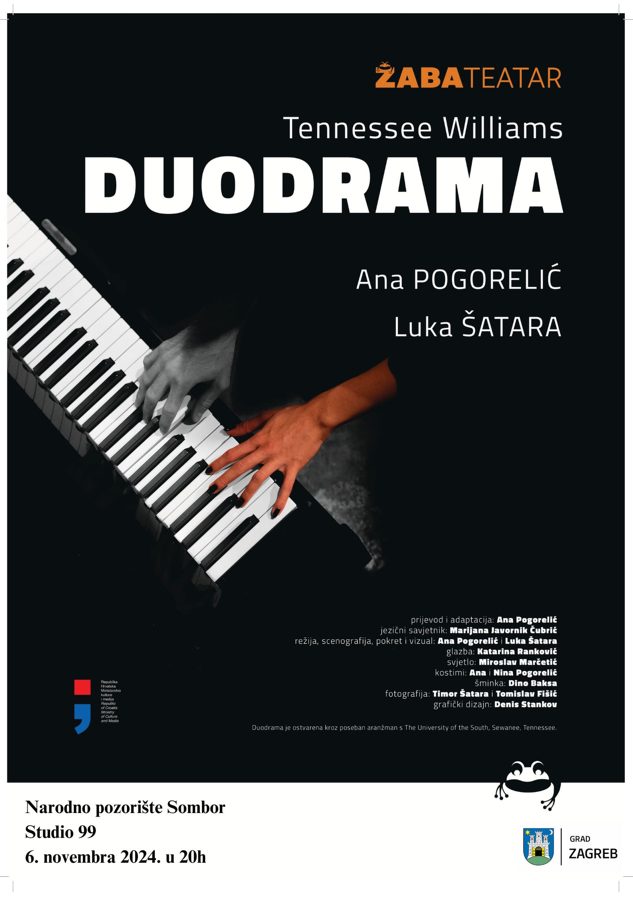
Translation and adaptation: Ana Pogorelić
Language advisor: Marijana Javornik Čubrić
Direction, scenography, motion and visuals:
       Ana Pogorelić i Luka Šatara
Actors: Ana Pogorelić i Luka Šatara
Music: Katarina Ranković
Lighting and tone: Miroslav Marčetić
Costums: Ana i Nina Pogorelić
Costume making: Đurda Prlić
Costume design: Franciska Topolovec
Make-up: Dino Baksa
Photography: Timor Šatara i Tomislav Fišić
Graphic design: Denis Stankov
„A garden enclosed is my sister“ (Song of Songs, 4:12)
The Two-Character Play premiered in 1967 at the Hampstead Theatre in London. Written over a period of ten years, the author described it as “my most beautiful since A Streetcar Named Desire, the very heart of my life.” Until now, the play has neither been performed in Croatia nor translated into Croatian.
I chose this translation of the title with attention to the wordplay between the title and the form of the work, as well as the evocation of the “play within a play” phenomenon on which this work is based. Williams also parodies himself and his own writing style. While the The Two-Character Play differs greatly in style from his classic works, it is interwoven with similar themes, re-examines the limitations of human existence, and contains autobiographical elements. The inspiration for this play was the author’s sister, who underwent a lobotomy in her youth, leaving her impaired for life. This medical phenomenon is also referenced in Suddenly Last Summer, but the character of the peculiar, neurotic woman recurs throughout Williams’ work.
The protagonists of The Two-Character Play are brother and sister, a pair of failed actors. Clare evokes the irresistible presence of Blanche DuBois from A Streetcar Named Desire, while Felice is a dreamer inspired by Williams himself. The play explores themes of repression leading to social isolation, mental instability and family tyranny. Unlike many of Williams’ other works, however, The Two-Character Play does not explore romantic or (homo)sexual love. Its language blends poetry and prose, and as the actors immerse themselves in the performance, the boundaries between reality and illusion – both on stage and in life – become increasingly blurred.
Ana Pogorelić The performance includes a fragment of Heitor Villa-Lobos’ Bachianas Brasileiras No. 4, performed by the São Paulo Symphony Orchestra under the direction of W. Polistchuk.
Duodrama is our fourth production. Previous titles included Silk by A. Baricco, Illusions by I. Vyrypaev, and Delirium for Two by Eugène Ionesco. We extend special thanks to Mrs. Elica Osvald, without whom none of this would have been possible.
We are grateful to the Ministry of Culture and Media of the Republic of Croatia for their financial support of The Two-Character Play, to the ensemble for their enthusiasm, and to all our friends for their invaluable help. This production was realized through a special arrangement with The University of the South, Sewanee, Tennessee.
The performance includes a fragment of Heitor Villa-Lobos’ Bachianas Brasileiras No. 4, performed by the São Paulo Symphony Orchestra under the direction of W. Polistchuk.
„A garden enclosed is my sister“ (Song of Songs, 4:12)
Translation and adaptation: Ana Pogorelić
Language advisor: Marijana Javornik Čubrić
Direction, scenography, motion and visuals:
       Ana Pogorelić i Luka Šatara
Actors: Ana Pogorelić i Luka Šatara
Music: Katarina Ranković
Lighting and tone: Miroslav Marčetić
Costums: Ana i Nina Pogorelić
Costume making: Đurda Prlić
Costume design: Franciska Topolovec
Make-up: Dino Baksa
Photography: Timor Šatara i Tomislav Fišić
Graphic design: Denis Stankov
The Two-Character Play premiered in 1967 at the Hampstead Theatre in London. Written over a period of ten years, the author described it as “my most beautiful since A Streetcar Named Desire, the very heart of my life.” Until now, the play has neither been performed in Croatia nor translated into Croatian.
I chose this translation of the title with attention to the wordplay between the title and the form of the work, as well as the evocation of the “play within a play” phenomenon on which this work is based. Williams also parodies himself and his own writing style. While the The Two-Character Play differs greatly in style from his classic works, it is interwoven with similar themes, re-examines the limitations of human existence, and contains autobiographical elements. The inspiration for this play was the author’s sister, who underwent a lobotomy in her youth, leaving her impaired for life. This medical phenomenon is also referenced in Suddenly Last Summer, but the character of the peculiar, neurotic woman recurs throughout Williams’ work.
The protagonists of The Two-Character Play are brother and sister, a pair of failed actors. Clare evokes the irresistible presence of Blanche DuBois from A Streetcar Named Desire, while Felice is a dreamer inspired by Williams himself. The play explores themes of repression leading to social isolation, mental instability and family tyranny. Unlike many of Williams’ other works, however, The Two-Character Play does not explore romantic or (homo)sexual love. Its language blends poetry and prose, and as the actors immerse themselves in the performance, the boundaries between reality and illusion – both on stage and in life – become increasingly blurred.
Ana Pogorelić Duodrama is our fourth production. Previous titles included Silk by A. Baricco, Illusions by I. Vyrypaev, and Delirium for Two by Eugène Ionesco. We extend special thanks to Mrs. Elica Osvald, without whom none of this would have been possible.
We are grateful to the Ministry of Culture and Media of the Republic of Croatia for their financial support of The Two-Character Play, to the ensemble for their enthusiasm, and to all our friends for their invaluable help. This production was realized through a special arrangement with The University of the South, Sewanee, Tennessee.
PREMIERE: 13. 4. 2024., Kazalište Mala scena, Zagreb
Performances:
Kunst Teatar Zagreb, 13. 6. 2024.
PagArtFestival, Stari Grad Pag, 7. 8. 2024.
Kazalište Mala scena Zagreb, Mali gornjogradski festival, 25. 10. 2024.
Teatar Vuk Beograd, 5. 11. 2024.
Narodno pozorište Sombor, 6. 11. 2024.
Zagreb, KUC Travno, 26. 4. 2025.

© Sciomagis | All Rights Reserved